7/15/2005

Sahara Hotnights interview


Sahara Hotnights Interview
 

Interview with lead singer Maria Anderson by Alexander Laurence

Sahara Hotnights are four women in their early 20s who are from a little northern town in Sweden. Out of boredom, they started playing together in their pre-teens. When they were around fifteen they played at a "Battle of Bands" contest. The winner would get to record their own demo in a studio. Sahara Hotnights won and their story begins here.

They recorded an EP titled "Suits Anyone Fine" and became a big live favorite around Sweden. In 1998 they had enough songs to start thinking about doing a proper album. In late 1999 they released their debut album "C'Mon Let's Pretend." It took the country by storm. They kept touring and in the summer they got the award for best live band by the biggest Swedish newspaper. They also played to a full crowd at the Hultsfred Festival. They took a year off and then recorded Jennie Bomb, their most successful album yet. With an international interest in Swedish bands like The Hives and International Noise Conspiracy, Sahara Hotnights soon caught on outside of Sweden. Currently, they are touring the USA for the first time. I met the lead singer and guitarist, Maria Anderson (3rd from front), in Hollywood recently. We talked about the band and we got to hang out at Book Soup. Maria ended up buying Spin and a book by JT Leroy. The band has a long two month tour ahead. Did we mention they are really hot?

________________

AL: How old were you when you started the band?

Maria: We were eleven or twelve. I don't know why we did. We weren't a manufactured band. Nobody told us we should play. When we released our first EP in 1997, we were like fifteen of sixteen at the time. I don't know if people see us as kids or they see us as a band. We thought we were a band like other bands. We never thought about how young we were.

AL: Do you still play stuff from the earlier EP and first record?

Maria: We don't play the EP, but we play three songs from the first album. The first album has similar songs to the new one. It's sounds different. Jennie Bomb is a better produced album. It sounds like what we sound like as a live band.

AL: When do you know it's time to go into the studio to make an album?

Maria: We always have precisely enough songs to make an album when we go into the studio. We take thirteen songs into the studio and hope that they all turn out good. We use them all. Most bands that I know go into the studio with forty songs. We only write songs that would be good enough to be on an album.

AL: Who writes most of the songs in your band?

Maria: Me and the drummer Josephine write all the songs. We write all the music in the band. I write all the lyrics. The other members help us out with the songs. They come up with ideas all the time. When we put the song together in the rehearsal space we all contribute.

AL: The band The International Noise Conspiracy is a band that foregrounds many intellectual and political ideas. As a band do you also deal with politics in any way?

Maria: I think that we are a socialistic band. Being a socialist is just having common sense. It's really sad when young people don't give a shit. We just had an election in Sweden a few weeks ago. It's really interesting. Thinking about all the different parties is not so fun. There are other things about politics than the separate parties. The historical aspects of politics are more important too because it affects your daily life.

AL: Many people here see Sweden as a sexually open place because people here are made to feel bad about their sexually, so it's really repressed....

Maria: I know. I couldn't live anywhere but Sweden because as you said it works so good. The welfare system and all that. But at the same time it's getting together with the European Union. There are a lot of right wing politicians who are successful in Europe. It feels that it can happen in Sweden. But now the right wing party in Sweden did the worst in the recent elections since the 1940s. That was a good thing.

AL: I read somewhere that your band was described as "hardworking."

Maria: Well, we tour a lot. We play about one hundred or more shows per year. We will tour for one month and then we will take a month off. We played the Reading and Leeds Festival this year. We are going to play Japan next year.

AL: What do you think of The Donnas?

Maria: We toured with them in Europe two years ago. It was fun. I like them. They are more like a concept than a band. They write about boys and rock and roll. Rock music is about that stuff. I would feel stupid myself only writing songs about that. But it's very hard to be that simple. Most people try to develop and expand. It's easy to compare us to The Donnas or The Runaways because we are all girls. You don't know if they compare us to The Runaways because they actually get the same feeling with them as with us, or because they can't think any further.

AL: Do you know much about Rodney Bigenheimer or Kim Fowley?

Maria: I met Rodney Bigenheimer. He was nice. I don't care about legends.

AL: What are your shows like?

Maria: We play songs from both albums. We play to a very mixed audience. People should have expectations when they come to see us.

AL: Do you see yourselves as a live band?

Maria: I think that every rock band sees themselves as a live band. That's what you do, like we do, one hundred days a year or more you are on tour. You go away for three or four weeks at a time. It is honestly more fun to play live than to sit all day in a recording studio. You feel smarter in the studio because you can work on the songs. It feels good making the songs. I don't know anything about computers or the recording process. It's boring to talk about the technical things.

AL: The name of the album is "Jennie Bomb." Is that a reference to Jennie Asplund?

Maria: Yeah, it's our tribute album to her. It's not a concept album at all. We wrote all the songs in a very short time. It was like five months. It was the same style as the previous album. But on the previous album we had used songs that were five years old.

AL: How did you write "On Top Of Your World?"

Maria: I wrote the guitar riff and the chorus at home. In a rehearsal we came up with a verse and the rest of the song.

AL: Do you read many books?

Maria: Yeah. We have much time on tour. I read many biographies of other bands. Right now I am reading a book about the Mafia and Italy. It's about the 1980s.

AL: Do you watch many films?

Maria: We don't have a VCR on the bus. I watch movies when I am at home. I like a lot of films by Hitchcock. We saw Spiderman on the flight over here. It was pretty good. I that film Amelie.

AL: Do you live with your parents?

Maria: No, we moved out when we were seventeen. We all live in Stockholm actually. When we get home, and when we have free time we just lay around at home. Where we come from there is nothing to do if you are a teenager.

AL: Are there many bands in Stockholm?

Maria: Yeah. There are not a lot of Swedish bands from Stockholm. Most bands want to move there. It's the center. It's expensive but everyone still insists on moving there. Most of the record companies are there. We are on RCA Sweden.

AL: Who has the best sense of humor in Sahara Hotnights?

Maria: Probably all of us together. We are not funny individuals.

AL: Who is the lazy member?

Maria: Jennie thinks that sleep is the most important thing. On the weekends you get really frustrated when you are on tour and you can't get any sleep.

AL: Do you play any cover songs?

Maria: We play a song by Suzie Quatro. We play a song by The Undertones. The songlist changes every night.

AL: What other bands do you like?

Maria: I like Devo, Magazine, The Go-Gos, and Johnny Cash.

AL: Do you have any advice for young girls who may want to play music one day?

Maria: No. AL: What do you see the band doing in ten years?

Maria: I don't know. We hardly ever talk about the future because it would make us nervous and depressed. I think that we should honestly quit as a band before we get too old. You shouldn't be playing rock music when you are over thirty. I don't want to. It depends on when you started too.

7/11/2005

Lunar Park


Bret Easton Ellis does an awfully good impression of himself.
LUNAR PARK, August 16, 2005, http://www.2brets.com

7/10/2005

Arab Strap Interview


During the CMJ Festival I spoke with Aidan and Malcolm from Arab Strap. They were staying at The Gramercy Hotel. I had just seen an interview with them in The Face. They were interviewed by model Helena Christensen, who claimed to be a big fan, which seemed unlikely. There were pictures of her with Aidan's arms around her. This was a bizarre matching.

I am big fan of Philophobia, one of the darkest records ever made. Arab Strap has been together about ten years and are from Falkirk, Scotland. In the recent year, America has seen the release of Elephant Shoe and a live record, both on Jetset Records. Malcolm Middleton and Aidan Moffatt have been an inspiration to many, including Belle & Sebastian, who named a record after them. I never liked Belle & Sebastian, and was surprised that fans of this horrid band tended to like Arab Strap as well. I found myself waiting outside the Bowery Ballroom to see Arab Strap with a bunch of B & S nerds. I feel like Jack Black in the film High Fidelity when the other nerdy guy puts on their lame-ass records.

Malcolm and Aidan ordered a coke, talked about seeing the new Exorcist and playing video games. Their show was gloomy and bizarre. People were really quiet and respectful.
*****
AL: Have you toured in America often?
Malcolm: We toured for two weeks in 1998. Mainly in the Northeast.
Aidan: We just finished a long tour with Tindersticks.
AL: You toured with Dot Allison about a year ago.
Aidan: That's right. She's doing quite well over here. She was better received here than in the UK. I was surprised that she was supporting us.
AL: You did a remix of a Dot Allison song.
Malcolm: Yeah. We don't do many remixes, but it's something to do. That was the least special remix we did.
Aidan: It's fucking amazing. We do remixes when we have time. It depends if we like the person who gave us the tape.
AL: How do you feel about Belle & Sebastian calling their record The Boy With The Arab Strap?
Aidan: They have a sense of humor.
Malcolm: Because Arab Strap is quite an interesting name. The words go well together. That's why we chose it as a band name. We're friends with them, but there's a limit to putting someone else's name on a album. They’re taking away something from us.
AL: Did people think it was an Arab Strap album?
Malcolm: Uh. yeah.
Aidan: Helena Christensen did.
Malcolm: Many people bought it because they thought it was a collaboration between both bands. We still see them around in Glasgow.
AL: Is it hard living in a small town?
Malcolm: People in Scotland don't like to see other people do well for themselves, for some reason. It's a Scottish thing. We don't talk about being in a band to normal people. You have to be in a band to have any interest in touring Japan or America. They wouldn't understand it or appreciate it.
Aidan: Most of our friends are somehow connected to a band.
AL: Elephant Shoe was release quite a while before in the UK. Why the delay?
Malcolm: It came out a year ago in September on Go Beat Records. It was a fiasco. We couldn't manage to get it released over here in time. The live album will be coming out on Go Beat and Jetset in January at the same time. We hardly played any songs from Elephant Shoe the other night, because we played it to death for a year.
Aidan: The live album is material from the first two albums. The first two albums were released on Chemikal Underground, then we went to Go Beat briefly, and now we're back on Chemikal Underground this year, which is run by The Delgados. That's their label.
AL: So you will come back to do a proper tour?
Malcolm: Yes. Since we are back on Chemikal Underground, we can have more control over what happens. Our next album will come out in February and it should be synchronized so it comes out here at the same time. Hopefully there's not a fuck up like there was with Go Beat.
AL: Go Beat is probably more concerned with Gabrielle?
Aidan: She's doing quite well.
AL: How did you guys meet up? Was there an idea that you would form a band from way back?
Aidan: I'd like to think that some greater force predestined it. It was always in the cards.
Malcolm: When we were 19 or 20, we were always in bands and stuff. It's such a small town that you meet people who listen to the same kind of music. We just decided to do some stuff together. Aidan had done some demo tapes himself, under the name Arab Strap. It was good.
AL: So you were the original Arab Strap?
Aidan: Not in any good way.
Malcolm: We had sent off some tapes to nine or ten labels and when Chemikal Underground wrote back we were shocked. But it seemed natural too because we were confident about what we were doing. After we finished the first record, the label said you have to play and promote this record in two weeks time.
AL: How did you feel about that, Aidan? You look uncomfortable up there onstage?
Aidan: No. Not really. I enjoyed it. Everybody gets in a bad mood.
AL: You pace around onstage. You fidget with the gear. Or you look for a beer.
Aidan: You need a drink, definitely?
AL: Is drink a major influence?
Aidan: It comes enough.
Malcolm: It's one of the pitfalls of touring with a band, because there's nothing else to do. You get to the venue, and it's usually a bar. It's usually in the middle of nowhere.
Aidan: We're becoming more professional though. We're very conscious of not drinking too much before playing live. Because the first two and half years of playing we just got totally wasted. It was very amusing to watch but it wasn't very musical in any sense.
AL: What about the songs?
Malcolm: Aidan writes all the lyrics and we both write the music. It's not just about writing, it's about actually producing ourselves. We make the songs on tape. We both come up with ideas. We used about three studios in Glasgow.
AL: Why do you write these sort of lyrics?
Aidan: I just write to piss off my girlfriend.
AL: The lyrics seem like a diary.
Aidan: I never kept a diary. I like to think of the album as a diary. Just key events. Just what I'm mulling about at any given point. I like to mull. That's something I'm very good at.
Malcolm: Some journalist described it as picking scabs once.
AL: But from what part of the anatomy?
Aidan: The brain. A scabby brain. I don't care what anyone says. Doesn't matter.
Malcolm: We have that advantage. We always made demo tapes for friends and each other. We always made records in the same way. We have no notions of a third party hearing the songs. The records are very intimate.
AL: It's also unique. You or anyone would be hard pressed to find an influence. Do you think that this music is agitated or is it something you can chill out to?
Aidan: I think that you can take it both ways. There's a lot in the records to relax to but there's also a bad mood. I like to encourage that.
Malcolm: People can relate to the subject matter of the songs. It's not stuff that many people sing about. It's not about "Oh baby I miss you." It's the small things that everybody can relate to. It's a record you want to listen to by yourself, not with friends or at a party.
Aidan: I like making records for the stoners as well. There's a lot of interest in us from the stoners.
AL: What do you think of some of the focus on Scottish music, especially now with Travis?
Malcolm: Travis is fine. They are just one of those bands, like Texas, which are, from our point of view, harmful to music. Travis is selling a shitload of records, that you can get them now at supermarkets, all over the world. It's just pop music.
Aidan: Music to buy at a supermarket. Meaningless.
AL: It seems like you guys utilize silence and quietness in your songs. It means more when you hear those blank spaces. When someone is talking it just ruins the effect.
Aidan: I was really impressed at the level of silence in the audience the other night. I was surprised because it was a CMJ show and people get in free and they could not give a fuck. They could just chat among themselves.
AL: Do you have any other hobbies?
Aidan: I have a Dreamcast actually. I like to play that whenever I can.
AL: Do you get on the Internet and check out what people are saying about Arab Strap?
Malcolm: Occasionally, yeah. The official site doesn't have much on it. The unofficial one has more activity. It takes up a lot time.
Aidan: I don't pay any attention to it at all. If I had an Internet connection I would just look at the Star Wars sites anyways.
AL: You were talking about the Exorcist. Did you like it?
Aidan: I think it's a wonderful film. But they ruined it by adding on a terrible ending. Stupid.
Malcolm: I hate stuff like that. Imagine that they re-released an album in ten years time with overdubs on it. Took bits out and change bits. Surely you don't touch it once it has been made. They always come out with director's cut.
Aidan: The Star Wars Special Edition was terrible as well. It's just pointless. The time and the feel of a film when it was made and released is very important.
AL: Do you have a personal messages to the fans out there?
Aidan: Buy our new record.
Malcolm: I always like to say to our fans, "Please don't be an asshole." And "Be good to your Mum."
AL: Are these words to live by?
Aidan: I'm a total asshole and I'm rotten to my mother. Don't shit where you eat.
AL: Don't shit what you eat?
Aidan: Actually I have to make a trip to the bathroom quite soon. It's annoying when people pay money to see you and act like fucking idiots when you're on.
Malcolm: It's perfectly understandable. They might have a few drinks. They might get excited.
AL: Some girl might have something slipped into her drink. Then she jumps on stage and takes off her clothes. She goes crazy.
Aidan: It doesn't happen often.
Malcolm: There's this image of us being these mad Scottish alcoholics. People outside Scotland think this is how we are and we'll do the same. Bunch of drunks. Just buy our records and not the other guys.
AL: I'm going to go home right now and put an Arab Strap CD in the player and glue it shut.
Aidan: That would be wise. Wait till the new record comes out though.
******

7/09/2005

The Portable Infinite Mix #4


I have been up all night. I decided to put this together, since the last one sort of fizzled, and I didn't do anything new in June. I didn't send out too many of the last one either. Number 3 is the rare one. I was going to include some new stuff from The Coral, The Raveonettes, Richard Hawley, The Warlocks, and other fabulous artists, but there are anti theft devices on those CDs. Also there haven't been a lot of cool records that have come out in the past two months. Most of them are here. Plus some repeats like LCD Soundsystem and MU, since those are some of the best records of the year. Some older stuff like Delgados and BJM made it on here for various reasons. Check it out:

1. Annie "Happy Without You"
2. LCD Soundsystem "On Repeat"
3. The Kills "Love Is A Deserter"
4. The Delgados "I Fought The Angels"
5. Stina Nordenstam "Winter Killing"
6. The Secret Machines "Better Bring Your Friends"
7. The White Stripes "The Denial Twist"
8. Gorillaz "Kids With Guns"
9. The Tears "Refugees"
10. MU "Tigerbastard"
11. Foreign Born "The Entryway"
12. The Greenhornes "I'm Going Away"
13. Patrick Wolf "The Libertine"
14. X-1 "New York Is So Cool"
15. Gliss "Blue Sky"
16. Mercury Rev "In A Funny Way"
17. Brian Jonestown Massacre "Servo"

7/08/2005

Dot Allison Interview 2002


DOT ALLISON
An Interview with Alexander Laurence


Dot was born Dorothy Elliot Allison, on 17 August 1969, in Edinburgh, Scotland. In the early 1990s, she was the lead singer of One Dove. It was a band that made a major contribution to the club scene, as comedown music in the morning. The implosion of One Dove amid record label wrangles and band arguments disappointed the multitudes that had relied upon the Scottish trio.

Five years later, Allison emerged from the wreckage and a serious car accident and signed to Heavenly Records. With the instrumental talents of Mani (Stone Roses, Primal Scream) and Kevin Shields (My Bloody Valentine), and lyrics from legendary songwriter Hal David, 1999's AFTERGLOW was not a radical departure from her former band's sound. It featured dub excursions, dynamic pop and heartbreaking songs. Her live shows, complete with a string quartet found Allison tipping her hat to Beth Orton and were always spectacles. Her latest, WE ARE SCIENCE, is a mixture of electro and folk music without the pop narcotics. It showcases her ability in programming and her embrace of the new electro music.
______________
AL: What are your sets like nowadays?
Dot: I started playing a One Dove track. I play a couple of tracks from Afterglow. I play an instrumental version of one song, "Mo' Pop," that is one part "rocky" and has uptempo guitar. Wait a minute, I am just getting into a taxi. I like the older stuff when it gels with the newer tracks. I think that it is important to play the back catalogue because it's part of my history.

AL: Have you been DJing a lot in the past three years?
Dot: I have been doing it more and more. I do it in London quite a lot. Then I ended up with a residency in Barcelona. I played at Arthur Baker's club in London and he liked my set. He wants me to go on tour with him in Europe and New York.

AL: What sort of records have you been playing?
Dot: A mixed bag of electronic music. It's quite uptempo. Even my album is quite like warm up tracks as opposed to mid-set tracks, excluding the remixes. I have been playing the same stuff for years: electro and techno tracks.

AL: There was one track that was a B-side on one of your earlier singles called "Melted." Was that a precursor to a lot of the electro stuff that you did three years later on We Are Science?
Dot: Definitely. I was listening to electro then but it didn't fit in with the rest of Afterglow. Afterglow was more of a classic pop album. Yet there was a couple of B-sides that were electro, and "Melted" was one, and another one "Mr. Voyeur." On that one I actually sampled Gary Numan. That was during the Afterglow sessions. That was indicating where my head was at although it wasn't reflected by the album much.

AL: Do you like Ladytron and Adult.?
Dot: Yeah, I do. I like Adult. and Le Car. Le Car was a precursor to that. I like almost everything on that Ersatz Audio. Most of the groups on that label are really great.

AL: Are you a member of Death In Vegas now?
Dot: No, I just collaborated with them on two songs. It's like Massive Attack or something, where there is two core members and a cast of long-time collaborators who come and go. I am just one of those collaborators in Death In Vegas.

AL: You recorded the early parts of this record in upstate New York with Dave Fridmann at Tar Box Studios. What was that like?
Dot: Oh, that was brilliant. They are all talented musicians and lovely people. It was an enjoyable session. I am a big fan of Mercury Rev. I also liked the work that Dave had done with The Flaming Lips. I like the fact that Dave Fridmann is a technically proficient producer. He's good at recording and at the same time he doesn't over-process things. He is able to keep the human element and it sounds like a performance as well. Tarbox is a music studio that is in the middle of the forest and it's quite remote. It's a real beautiful surrounding to make music in. There's no distractions. It's better to be in nature than in a London studio with madness outside.

AL: Did you take a lot of time off after the previous album?
Dot: Not really. I spent a lot of time sorting out my new studio. I bought so much new equipment. I had my head in the manual just working. I was troubleshooting with the new gear because I changed my software package. I changed to Logic. It wasn't a big leap. I also moved into a new apartment. My prized possession is an Arp Odyssey which is quite cool. I had a digital analog too. Some of the sounds are cool even though it's a digital keyboard.

AL: Were the songs "Strung Out" and "Lover" written before most of the new album?
Dot: They were written first. When I was out touring Afterglow I was already playing them live. They were already in existence and had life and had arrangements at that stage. Since they were guitar based and guitar lead I knew that I wanted to work with someone like Dave Fridmann. At the same time I knew I wanted to make a diverse but quite electronic album. I wanted to have all those loops and samples and also have guitar tracks near to keep it "space rocky" and electronic like a bad marriage.

AL: When did you work on the new album and when was it released in the UK?
Dot: I finished it about a year ago and it came out in April.

AL: How did you write this album? Afterglow had a bunch of piano based songs.
Dot: Probably in a similar way. I did more programming. I still like to sit down with a guitar and worked out chords. My primary instrument is piano really. I work out chords and play them in parts and edit them on my computer. I experiment a lot now too with the computer. I play around with bits, playing them backwards and transposing them. You can record parts and put effects on them, and then re-record them with other effects. You can keep processing things till you get something original. I always spent time on pre-production. I always came in with templates of songs that I had sampled up with Afterglow. I always had bags of records and notepads with notes of which songs and which parts I wanted to sample. I had a rudimentary setup in my flat and not a very good computer. You need a lot of memory for some samples. Now that I changed systems I can record all that on my hard drive.

AL: Are you going to do an American tour soon?
Dot: I like being in America. I would like to come back as soon as I can really. I would like to do an acoustic tour as a tastemaker of the songs on this new album that I can do that way. I can play some stuff from Afterglow and One Dove. Then I can come back again with a full band. I have been touring in Europe all year. I think that it has come of age as a live set. So I can't wait to bring it over.

AL: Have you read any good books recently?
Dot: I read the "His Dark Materials" trilogy by Philip Pullman. It was really cool. I read "Atomised" (The Elementary Particles) by Michel Houellebecq. It's quite bleak.

AL: Have you seen any films recently?
Dot: Yeah. I saw Almodovar's "Talk To Her." It's the new one. It's good. There's a British comedy called "Once Upon A Time In The Midlands" with Rhys Ifans. The guy who was in Notting Hill.

AL: I heard that the Marquee Club opened again in Islington.
Dot: I went to the opening. It's cool because Primal Scream played. It's quite a small stage to see them on so it was like a treat. It was good. They really rocked. Everybody was going mental. I have worked with Mani before on Afterglow. He said that he would be on my next record. We agreed that he would be on a couple of tracks on my next record. So I am going to hold him to that. I have worked with Andrew Innes and Kevin Shields too. So I work with them one by one but never together.


7/07/2005

Mr. Airplane Man


Mr. Airplane Man
interview by Alexander Laurence

Mr. Airplane Man is a Boston duo, Margaret Garrett (guitar, vocals) and Tara McManus (drums, keyboards), who have been playing since 1996. They named themselves after a Howlin' Wolf song. Their obsession with rock and roll music since early high school inspired the band. They began playing on the street and by 1999 they were voted Best New Local Act by readers of the Boston Phoenix.

They recorded their first full-length record in March 2001. It was raw and real. They played with the White Stripes and the Strokes, as well as local Boston curiosity the Lyres. When they recorded their second record, Moanin', they got to work with Jim Diamond and Greg "Oblivion" Cartwright. John Peel soon discovered them too and had them do a session. This lead to their first European tour, which was highly successful.

Mr. Airplane Man played many large tours of America in 2003. In the meantime they were back in Memphis where they recorded their third record, C'mon DJ. This record exceeds all expectations. I got to talk with Tara McManus soon after they had finished an American tour.

AL: When did you start the band?

Tara: We have been playing together since 1996. We actually formed the band around 1998. We had a few people coming in and out of the band. But about five years ago we decided that the two of us was good enough and we didn't need other people. We couldn't find anyone who wanted to do what we wanted to do. Many people who are into the blues have a real icky take on it. It was like they were into the blues but didn't like rock and roll. Or they were into rock and roll and they knew nothing about the blues.

AL: How many shows have you played together?

Tara: I don't know. There have been a lot of shows. When we first started playing in Boston, we played a few times a week every week. We played in pubs and we played on the street every day. They just made it illegal to play in the subways in Boston. We have done a lot of tours now.

AL: Not many bands from LA or NYC play more than one a month. Maybe they play once every three months or so.

Tara: The pub scene is really cool. They book bands to play once a week. People just like to go out. It is a good way to get a following. Once you want to play rock shows with bands from out of town, you have to stop doing that. The rock clubs will not book you if you are playing all the time. We learned to play by playing all the time. I am sure some of those early shows were pretty bad. They were supportive anyway. You get free beer and a little money.

AL: Have you been playing music for a long time?

Tara: Margaret did. She has been playing for a long time. She was always writing songs. I didn't start playing until 1996. Her family had classical musicians in it. My parents were big music fans. We always had records on.

AL: Does your family come to your shows?

Tara: Yeah. They like our records. My dad comes out to shows. It's usually too late in the night for my mom to come down. My dad lives near Pittsburgh, so whenever we play in Cleveland, he drives out. He hangs out. He is really into it. We have been on tour all this year. I lost my job in Boston because I had to take time off to do these tours.

AL: What do you do when you get back home?

Tara: It's rough. I try to pick up shifts at different places. I have been out of work for two weeks. We don't make enough money on the road. Somehow we manage to scrape by. We should be on the road more often.

AL: Have you played in Europe yet?

Tara: Yeah. I am excited to go back in February. We have only played in England not in the rest of Europe. We are going to do another John Peel Session and we are going to play in other parts of Europe too.

AL: How is it different over there?

Tara: It's really weird. We were over there for ten days. By the end of the ten days we were playing to really big crowds. It was really strange. It seems like in America it takes so long to build up a big crowd. It's such a grind in America. It's much easier over there. People are more receptive and cool, and all the shows are more fun.

AL: People seem like they are informed about music over there. They seem to know about a lot of bands.

Tara: Every shows we played in England had DJs that were so good. They would play records in between bands. They knew we were from Boston so they would play The Lyres, The Real Kids, and others. All this great music that even people in Boston don't know about. We have played with those bands before. Boston hasn't been so hot for getting shows. They don't pay so much. We played this amazing show with The Real Kids this past summer and they got paid fifty bucks. It's really sad.

AL: Some of those Boston bands never play a gig outside of Boston. No one has heard of them anywhere else. How come you play all over while they stay in Boston?

Tara: Margaret and I are younger than them. We will put up with not having any money or stability at all. Those bands have been through it so they won't travel anywhere unless they get a certain amount of money. I guess The Lyres are not going to leave town anymore after the LA Shakedown fiasco. It was bad.

AL: Yeah I went to that. I couldn't even get into the venue the first night. What happened?

Tara: Yeah. That was ridiculous. When we were setting up for our show, I was thinking that the promoter, Ralph Carrera, is having breakdown. The truth is that no one got paid. The Lyres had to pay eight thousand dollars out of their own pocket. They paid for their airline tickets and hotels and they were supposed to get paid back and that never happened. It's not like the members of those bands have a lot of money in the first place. They said afterwards that they were never leaving Boston.

AL: Are there any other bands that you like?

Tara: I have been into The Broke Review for a few years. I am obsessed with them for a while. I like The Cheater Slicks. We got to play with them a few times this Spring. They blew my mind completely. I like The Reigning Sound.

AL: You have played songs by Howling Wolf and The Outsiders. How do you pick which songs you will perform or record?

Tara: We do songs that we really like. Things just click right away. We try to do a lot of cover songs but they just don't end up working. There are certain songs that we can do our own way. Many of the songs are just what we are listening to at the time.

AL: You do "Hang Up" by The Wailers.

Tara: It's such a great song. It's one of the best songs I have ever heard. When I heard the original song, I thought this songs is so perfect, we have to play this. The drum beat and everything about it is great. I haven't heard it in a long time and then I heard it recently and I thought, "Oh man, this song is untouchable." I can't believe that we tried to do a version of it.

AL: When did you record the new album, C'mon DJ?

Tara: We recorded it in two different sessions. We did a week last fall (2002). We finished it up this past spring (2003). We recorded it in Memphis with Greg Cartwright.

AL: How did you meet him?

Tara: We were obsessed with his new band, The Reigning Sound. We were bugging him to do a show in Memphis. We went down there right when we were mixing the previous record. Moanin'. We played the show and our car broke down and so we were stuck in Memphis. Greg liked our band and said that he would mix the album. We made plans to record the next album with him. I am so glad that we did. It went really well. I am really happy with the sound.

AL: How did the first John Peel Sessions come about?

Tara: John Peel somehow got a copy of Red Lite. He played it all the time. He was really into it. He invited us to do a show. It's great because a lot of people really don't like Red Lite. They think it's too fucked up. They think it sounds that way because we didn't know what we were doing. They don't understand that we were going for that sound. When we did the first show we picked the option of just recording some songs. We didn't know that we wouldn't get to meet him. This time we are going to do a live show in the studio. It will be more fun.

AL: What songs did you do on John Peel?

Tara: We did "Red Light." We did an early version of "C'mon DJ" and The Wailers "Sun Going Down." Those were like the first time we played those songs.

AL: What are the plans for the band this time of year?

Tara: We are taking a break. Margaret is in Memphis right now. February we are going to do some shows. We will be coming to New York City. We will go to Europe, England, and then come back, and do a real big tour of the States in March 2004.

AL: Margaret writes all the songs?

Tara: Yeah. She writes all the songs. Sometimes she'll bring in parts of a song and we will make up the music together. We figure out the music and the arrangements together. She usually has all the ideas for songs.

AL: Are all the songs live takes?

Tara: Yeah. We did a few overdubs. During the live show I play drums and keyboards at the same time, but in the studio, I just overdubbed it. It's easier. All the microphones are all over the drums. There is too much in the way.

AL: Have you read any good books lately?

Tara: Yeah. I just read this book called "Camellia Street?" I am bad with titles and remembering names. I can't remember all of our song titles a lot of the title

AL: What do you do when Margaret says; Let's play "Commit A Crime"?

Tara: I don't know. I remember a few words. We have our little code system.

AL: Which show did you think was you best this year?

Tara: We had a really good time on the West Coast. The shows in LA and Portland were fun. We played at this unadvertised, after hours place. Everybody there was really cool and having fun. It's so rare that people are having a good time and dancing.

AL: Does it get too wild and people jump onstage?

Tara: No, never. I love that. It got like that in England. People were going crazy. It was fun. Many places we go to people are so reserved. People are often too self-conscious about being excited. I know if I like a band I go right up front and I am so happy and so into the music. It is fun when you have a group of people who are all that way. It's sad when you get this feeling like you are the only one who cares.

AL: People are trying to be cool.

Tara: That's what I mean: in Portland, Oregon people were truly cool because they were having fun and didn't worry about being cool.

AL: Do you have any recent favorite films?

Tara: I liked The School of Rock. I just saw it. We also saw American Splendor when we were on the road. That was really good.

AL: What is your favorite part of doing music?

Tara: Playing live is my favorite part. I don't like recording very much. I have learned to tolerate it and at moments it can be fun. But for me it's all about the live shows. That is why I do it. Ever since Margaret and I were little we have always lived to go see live music. We always went to shows together. I love the spontaneity of being in the moment with the music and the crowd.

AL: How old were you and Margaret when you started going to shows?

Tara: We were thirteen or fourteen. There were all ages shows on the weekends. We used to see punk bands all the time.

AL: Where are some cool neighborhoods in Boston? Where would we find the hipsters?

Tara: (laughter) I don't know any hipsters. I live in Somerville. Everyone is getting pushed out to Somerville. It's north of Cambridge. It's the next town further away. There is a bar there called The Abbey Lounge. That is where everyone goes. It's the only place that isn't a yuppie place. It's not expensive. They have a lot of rock and roll shows.

AL: Is that near Davis Square?

Tara: That is like the other side of Somerville. I never go there. People there are mostly college kids. They are all into Irish folk music and bluegrass.

AL: Do you have a lot of records?

Tara: Yeah. That is my entire life. We have three chairs at my house and fifty thousand records. I don't own anything except records. It's bad when you are on the road because you can buy records and be on the road and not pretend that you have any bills waiting for you at home.

AL: It seemed like it took a lot longer than usual to put out this album?

Tara: It's been since July. It was delayed because there was a lot of drama over the cover art. Someone was supposed to do our cover and then they flaked out at the last minute. All this stuff happened. It's been ready for a while.

AL: What is going on with this guy, Long Gone John?

Tara: He is awesome. John is great. He is a piece of work. He has so much heart. I love him. He is so cranky. He is so negative and really funny. He has put out some amazing records. I am glad we got to work with him.

AL: He is supposed to be a big art collector.

Tara: Yeah. We finally went to his house last winter. He has so much stuff. It was amazing. He has all these painting by Mark Ryden. I live in my own world. I have seen a lot of that art in magazines. When I saw that art in person I really liked it. It was impressive.

AL: Are there any other bands that you like?

Tara: We played with The Tearjerkers in Memphis. They are great. We just did a bunch of shows with The Husbands and The Demolition Doll Rods. I love The Dirtbombs.

Website: http://www.airplaneman.com/


7/05/2005

Allen Ginsberg Interview


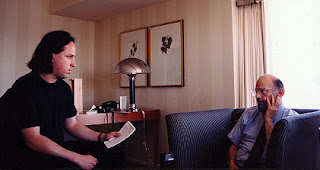
I met with Allen Ginsberg on his book tour for Cosmopolitan Greetings: Poems 1986-1992 (HarperCollins). I was accompanied by George Scrivani who was an editor, who created Hanuman Books with Raymond Foye and Francesco Clemente. I didn't get along so well with Allen Ginsberg \as is evident in the following.


I interrupted him every time he launched into a soundbite about the importance of the Beats.
He often questioned me about my questions. In
the interview, I stressed
the importance of obscure Beats including Kenneth Rexroth, Robert Duncan, Jack Spicer, Bob Kaufman, Ray Bremser, and Irving Rosenthal.
Alexander Laurence with Allen Ginsberg

In fact,
my mention of Sheeper being the best work of the Beat Generation, seemed to annoy Ginsberg. Later that day, Ginsberg read "Hum Bom!" at Candlestick Park and was booed by the apolitical and conservative baseball fans.

Ginsberg died in 1997.


Alexander Laurence: Cosmopolitan Greetings is your new book of poems which collects your most recent work: 1986-1992. Your poetry seems to have changed stylistically, especially in your delicate attention to language; I think of your earliest poems, such as Howl, possessing a complex use of language, utilizing many adjectives, and being influenced by Surrealism, yet the new writing is much more transparent, direct and simplified.
Allen Ginsberg: More or less, with the occasional touches of a surreal sequence of images. There are a number of poems in here and in White Shroud which are examples of complicated language or complicated dream situations. Within some simple poems are some surreal word chains, particularly "I Went To The Movie of Life," "Grandma Earth's Song," and in the Jacob Rabinowitz poem:

"Put me down now for not hearing your teenage heartbeat, / think back were you serious offering to kidnap me / to Philadelphia, Cleveland, Baltimore, Miami, God / knows, rescued from boring fame & Academic fortune, / Rimbaud Verlaine lovers starved together in boondocks houseflat / stockyard furnished rooms eating pea soup reading E. A. Poe?"


I want to have lucid clear pictures in my poetry rather than jump-cut, cut-up, chaotic flashes. I want my poetry to be like a cinematic movie. The magic comes not from the speed up of the words, but the magic comes from the fact that it's an imaginary dream vision. The prototype of that is Shelley's "Triumph of Life."

AL: But has your use of language become more simplified?
AG: It's become more lucid. Yeah. I've become interested in very clear one sentence poems. Like a snapshot. "I can still see Neal's 23-year-old corpse when I come in my hand." (American Sentences).
AL: You grew up in a Marxist, Jewish, leftist background. How did this influence your sexuality and politics?
AG: I wasn't bar mitzvahed. I lived across the street from a synagogue. My family was Jewish but they were all communists and socialists and atheists. They hated the orthodox rabbis. My great grandfather was an orthodox. There a poem called "Yiddishe Kopf" that directly answers the question about politics. How it influenced my sexuality I don't know, but coming from a bohemian Jewish background, that including free thinking, free love,
1920s modernist idealism; those were the ideas circulating at the time.

AL: How do feel about the idea that sexuality is related to writing?
AG: A lot of my writing is to attract lovers, like in "Personals Ad." There are a number of poems in here that are directly intended to make a homunculus picture of a young boy that I want to make out with. It rarely works out, but eventually the whole body of my work is a big personals ad. That's a big motivation, to make myself open and candid.
AL: Do you prefer pre-Stonewall homosexuality, repressed and closeted or ....
AG: No way!
AL: Is the gay revolution of the 1970s the best thing that happened?
AG: No. It was a good thing that happened. But the best thing that happened? Come on! Why do you treat it as a stereotype?
AL: I just wanted you to talk about pre-Stonewall activity.
AG: There were a large mass of people who were gay and who knew each other, and then there was police repression. The clubs and the gay bars were owned by the Mafia who paid off the police. Stonewall didn't pay off the police. Police corruption was really at the bottom of it all. For the mass of people it was a gay riot. It was a political action lead by the transvestites, they were the pioneers who fought the police. I don't think that there was that much psychological difference before and after Stonewall. Burroughs, Genet, Christopher Isherwood, and Gore Vidal had all written gay novels before then.

There was a lot of gay literature. It wasn't the internalization of homosexuality but the official repression by the police and the Mafia, who had a vested interested in it staying black market.

George Scrivani: Are you going to attend the 25th anniversary celebration of Stonewall in New York?
AG: I don't know where I'm going to be. If I'm in New York, I will be marching with NAMBLA.
AL: I wanted you to talk about political activism. My feeling is that it is based around single issue politics. This sort of activism is usually a reaction of "a society of the spectacle" scenario...
AG: I don't know what all this language and references mean. I don't know the relationship between single issue activism and spectacle. That is the language of the Situationists. I don't understand what logical link you are making.
AL: How has you view of Walt Whitman changed over the years?
AG: Is that the same question?
AL: No I changed it. I skipped that question.
AG: Why don't you clarify. Can you give me a clear idea of what you mean?
AL: Definitely!
AG: So can you say it in more simple language? I don't mind answering the question if I can understand it, but I can't.
AL: First, there is an activity called "Political Activism." This is a very popular activity in San Francisco. All over.
AG: Gay activism?
AL: That as well. It seems that...
AG: Which type are you talking about?
AL: Activism surrounding the Rodney King Trial, The Iraq War, and Act-Up for instance.
AG: There were anti-Iraq War demonstrations here in San Francisco?
GS: Yeah, it was big. But television distorted it.
AL: Yeah. The way media is structured now, most debates focus on single issue politics while ignoring the larger picture, which resembles a model set up by the Situationists, in Guy Debord's The Society of The Spectacle. Debord criticizes the fascination of the spectacle.
AG: The critique was that everything was reduced to unrelated theater. I don't know if the left or anyone has a unified field of activism. I'm not sure if the situation is so far out of control that there is any solution. One problem is over-population and another is hyper-technology, which are ruining the planet. Technology is ruining the planet, so the answer is "less power" but that's unlikely to happen. Does anybody disagree with a dark vision of the future? All pop culture is based on it.
AL: Everyone my age believes that they are inheriting several of these problems such as toxicity....
AG: And overpopulation. We have this privilege. We're all dependent on technology because we use electricity, even a cute magazine like Cups is dependent. Everyone in the West is complicit.
AL: There's not much cynicism in your work. You don't value that position about the world?
AG: That's a stupid young person's reaction towards the world. That's a person who doesn't sense their own value or worth. Given a situation like this, the most practical approach is creating some relationship to mass suffering. It's the difference between living with AIDS and dying with AIDS.
AL: How do you feel that the poets associated with The Berkeley Renaissance, such as Spicer and Duncan, and poets now referred to as The New York School of Poets, Ashbery, Koch, and O'Hara, differed from the Beat poets?
AG: The Beat Poets were close stylistically to The Berkeley Renaissance, but the Berkeley people were a little more literary, in a sense that they drew on a more elite literary tradition and language, derived from Neo-Platonic studies of the renaissance. As far as The New York Poets: we all went to bed together.

O'Hara was a close friend. We wrote poems to each other. O'Hara put the stamp of approval in New York, which was very important in those days, on John Wieners, and on Gregory Corso. Spicer and Duncan didn't care for some of the Beat Poets, but they respected Kerouac. Duncan had been a gay pioneer when writing an essay in the 1940s about being gay as a political act.

They thought that the Beat Poets took away some of the praise. We had certainly
gotten a lot of publicity. I wrote to Duncan "In unity there is strength." But he never joined us for any readings. Spicer always thought that there was some vulgarity involved, that Gary Snyder's work was too intentional, and that I wasn't sufficiently learned.

AL: In what I've read, you painted the history of poetry as cyclical and continuous, but a poet like Jack Spicer doesn't seem to fit in to the traditions that you talk about.
AG: He fits in. He wanted to be totally individual. He even fought with Duncan: certain metaphysical arguments.
AL: What do you think of the poets on MTV and performance poetry in
general?

AG: Poetry since Homer and Sappho has been performed. The minstrels. Pound and Yeats always stressed reading poetry aloud. They thought it was important. Pound's daughter said that her father always thought that the proper way to present poetry was through performance. It all depends on how sophisticated the is text on the page. If it looks good on the page it should sound good in the air. A lot of it is shit on the page and good in the air. A lot of it is shit on the page and shit in the air. And some of it is great on the page and great in the air.
AL: Speaking of shit, there seems to be a lot of preoccupation with the anus?
AG: Are you speaking about shit or playing with the anus? Doesn't everybody play around with the anus. I would say that a majority of people in America, whether they are heterosexual or homosexual, like to have their anus diddled with during copulation. Does that seem inaccurate?
AL: That's perfectly acceptable.
AG: Is that an accurate statement? Do the girls that you make out with like to have their anus diddled with? Not fucked in the ass, but...
AL: You have this poem "Sphincter" which reminds me of a Rimbaud/Verlaine poem. There is a tradition of anus poems.
AG: It's a universal theme. I wrote a poem after that which goes: "I got old and shit in my pants, shit in my pants....."
AL: How do you feel the gay homosexual imagination has contributed to 20th century poetry and how much have you contributed to this?
AG: My part has been minor. What I have done is to take gay, homosexual love and give it a dimension of ordinariness. So it's not a big deal. Are you gay?
AL: Um, well let me ask you another question.
AG: I don't understand. Is this a gay magazine?
AL: No. I interviewed Dennis Cooper in the last one, but it's not a focus.
Alexander Laurence is a writer who lives in Los Angeles. He has interviewed over 100 novelists, many of which are accessible through the Internet. His book reviews have appeared in The Review of Contemporary Fiction, American Book Review, East Bay Express, LA Reader, Bay Guardian, and American Book Jam.